
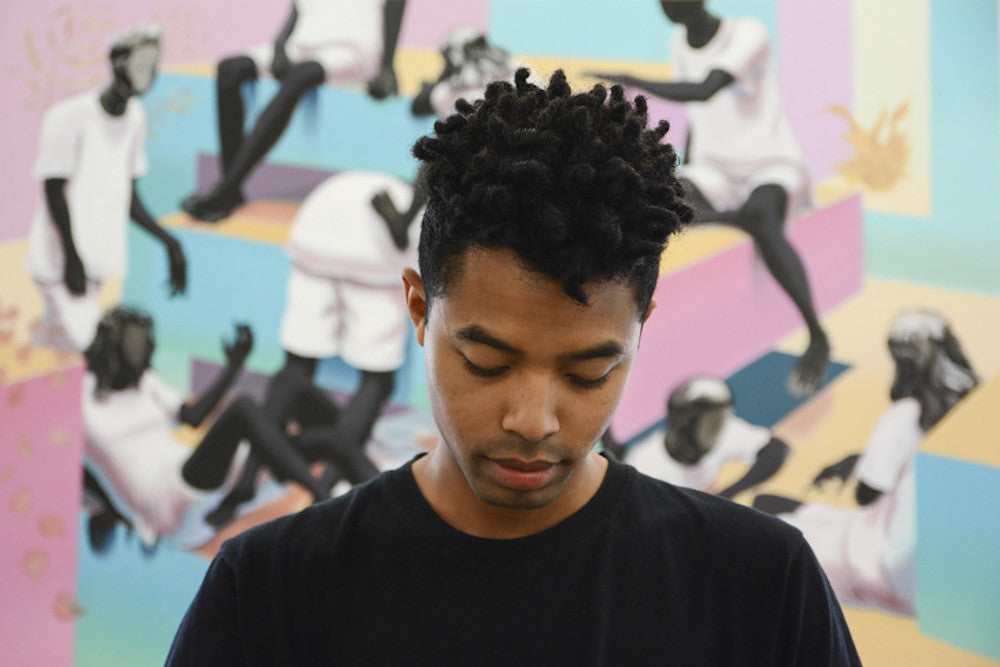
Interview: Alex Gardner
Photo credit: Linnea Stephan
Capturing meaning rather than labels through a painting where faceless figures convey emotion. Alex Gardner’s brushwork exudes a rare humility and honesty, with authenticity taking center stage in a masterful contrast of black and color.
How would you describe your art? My art is figurative. I try to capture the beauty of life—my own, and that of those I know and spend time with. I like the idea that, much like in films, every day looks the same until suddenly a deeper moment stands out. Focus. We stop, we zoom in on that particular moment, which could be romantic, for example. And the beauty of the detail emerges. That is what I try to convey in my painting.
Who were the main figures in your career? What are your inspirations? My career is recent, and I haven’t had much guidance in this regard. Furthermore, I don’t know contemporary art or its artists very well. I haven’t therefore been greatly influenced by them, but rather by music and cinema. My works are entirely linked to emotions, moods, states of mind… In this sense, music and films inspire me far more.
Where is the place where you can feel like yourself? I would say surrounded by my close friends, but also when I am alone. I am an only child, and I have spent—and still spend—a lot of time alone. It seems to me that this is when I feel best.

And when you travel, do you feel like painting? Wherever I travel, I am inspired. I can produce works anywhere, but I still need a dedicated space. I need a studio so I can get organized and immerse myself.
Do you have a ritual before you start creating? Not really. I wake up, have lunch, drink a coffee, and get started. I only create during the day. I paint all day like this, and when the sun sets, I stop. I never paint at night because I don’t have the right natural light. Artificial lights distort the colors. As a result, you can be faced with unpleasant surprises and a result far from what you had hoped for.
How do you choose your colors? I try to create beautiful colors—true and luminous—because the subjects that interest me are quite dark. A lot of darkness and sadness emanate from my characters. I bring contrast to them by using beautiful colors, thus showing two opposing facets.

Is a good artist an artist who sells? No, I don’t think so. Some artists benefit from good agents. But does the person who sells an artist know anything about art, or are they simply a good salesperson? I was recently at the Frieze Art Fair in London, where I saw a lot of works, different styles… Some good, some less so. In my opinion, a good artist is an honest artist who remains true to what they do. If these artists start selling in this way, “good for them!” Unfortunately, I think too many artists create works to sell, to become rich, and while I obviously don’t subscribe to the mechanism, I can only observe that it is not always good work.
In this era of aestheticism, how would you define beauty? Honesty is beautiful. Beauty is a kind of truth, something that reflects humanity and conveys an authentic message. There is far too much conceptual art that deceives, that tests the public, and which I accord no value.
Regarding your art, what are your limits? I have physical and technical limits. My body has its own limits, and practice allows me to improve and overcome technical constraints. It is a matter of training. But no one has limits when it comes to the mind!

Although it seems friendly, the wombat is aggressive when it is in a bad mood. Reveal one of your flaws or bad habits? One of my biggest flaws is that I am particularly negative, pessimistic. I therefore need to surround myself with positive people. My work reflects my states of mind and attitudes in all their complexities. To protect itself, the wombat blocks its burrow with its backside when it feels attacked.
What is your defense mechanism? I think I am generally reserved. I don’t like letting people get too close. I defend myself by avoiding being too emotionally vulnerable to others. I listen, I observe, and I remain quite secretive.
If I were Alex GARDNER, what question would you ask me? What can I wish for you? I hope to be able to sell my paintings. It is not about money, but I still need to pay my rent. As long as I can develop and improve my art, I am satisfied, that is enough for me. Is that little? “Sorry!”
Interview with Jessica SEGAN for Wombat.
Discover Alex Gardner’s print for Wombat.
