
Interview Ella Murtha
Ella Murtha is the daughter of photographer Tish Murtha. Interview and text in English.
Daughter of an Irish Catholic family, why did your mother Patricia Anne "Tish" Murtha and her 9 siblings grow up in the West End of Newcastle upon Tyne, England?
Tish’s paternal grandmother came from Co. Monaghan, Ireland. A wave of emigration to England took place between the 1930s and 1960s by Irish families seeking to escape poor economic conditions. Tish was born in South Shields, England before the Murthas settled in the West End of Newcastle, at the time a known hotspot for large, working-class families of Irish descent.

Where did Tish’s interest in photography originate?
Tish left school at 16 and had a variety of jobs, from selling hot dogs to working at a petrol station. Photography wasn’t part of her life until she took a photography evening course at Bath Lane, Newcastle, where her lecturer convinced her to apply for the Documentary Photography course in Newport, newly set up by David Hurn and the only one of its kind at the time. The same lecturer also helped her obtain an education grant, which enabled her to go.

In 1976, aged 20, Tish left home to study at the famous School of Documentary Photography at the University of Wales, Newport (set up by Magnum Photos member David Hurn)». Which lessons did she learn? And from a more technical point of view, is it where Tish started printing her own pictures “as an art form”?
Yes, that’s where she made her first prints, although she never really mentioned her Newport photos to me. My understanding is that she felt she had an obligation to the people and problems within her local environment back home in the North East, and that she chose to study documentary photography in order to enhance her skills and knowledge, making her a more effective photographer before returning home to highlight and challenge the social disadvantages that she herself had suffered. Of course, studying under David Hurn, she couldn’t have picked a better course to achieve her goal.
What was her message through her two controversial series Juvenile Jazz Bands (1979) and Youth Unemployment (1981)? Can you tell us a bit more about Tish’s personality and how she got the nickname “The Demon Snapper”?
It’s fair to say that Tish was known to have a feisty personality. The nickname “The Demon Snapper” came from her approach to her Juvenile Jazz Bands series. She initially had the backing of the people who ran the bands, who imagined her photographs would be ‘glamorous’. However, when Tish saw that the ordinary kids who played in the streets had been excluded from these groups because they didn’t have the money for uniforms and travel, this obviously resonated with her, so she photographed the bands in their finery alongside these kids from the back streets, imitating them. The Jazz Band committees were furious when they saw the finished series and labelled her “The Demon Snapper.”
Youth Unemployment in the West End of Newcastle portrayed what Tish saw as the dereliction of young lives amid the dereliction of an area with more than double the unemployment rate of the city as a whole. She had first-hand experience of what it was like to be young and on the dole, and so she wanted to try to help others who saw no real future for themselves by highlighting the issue.

Do you think her camera, which was initially both a weapon and a tool of defence when she was young, had then become a new kind of weapon, a way of expression?
Absolutely. Tish’s work captures the hardship that both she and the North East of England suffered during the Thatcher era. The fact that a newspaper review of Youth Unemployment, including an interview with Tish regarding her subject matter, was actually read aloud for debate in the House of Commons shows how lethal her ‘camera as a weapon’ was after honing her skill at Newport.
Why was Youth Unemployment her last solo show?
A combination of reasons. She found it hard to get her work exhibited and moved around a lot, without means to be contacted. She was deeply suspicious of the Internet—mostly because she didn’t understand it—and used to get exasperated when people asked for, as she called it, her “email number”, as she didn’t have one or want one. Unfortunately, Tish could be her own worst enemy and she was left behind by the digital age. She only ever used film. She continued to take analogue photographs of anything and everything, from refugee art groups and inside women’s prisons, and quite eerily, even a series on graveyards shortly before her death.

Who were Tish’s influences?
As part of her archive, we are fortunate to have lots of correspondence and notebooks that she kept, some of which mention her influences. She was a close friend of Chris Killip and loved the work of Josef Koudelka, among others.
If Tish were 20 years old today, what would she do? Who or what would she photograph?
Probably something on Brexit!
Last summer 2015, one of your relatives, David, contacted you after attending the For Ever Amber exhibition at the Laing Art Gallery, Newcastle upon Tyne (the first major account of the AmberSide Collection, lauded by The Independent as “Britain’s answer to Magnum”). Can you tell us a bit more about this encounter?
Yes, it’s a great example of fate. David went to the exhibition and wrote his first-ever blog post about it, which I found and “liked” online. Seeing my surname, he realised that I was Tish’s daughter and got in touch with me—until that moment, neither of us knew the other existed. As fate would have it, David is not only my second cousin (remember how big the Murtha family is!) but also a photographer himself. He asked me about her archive, which had just been sitting in a box since her death, and we made plans to meet. The following weekend I attended David’s wedding, and a few weeks later he launched the tishmurtha.com website. It’s an amazing story, really. We have a blog post on the website which explains in more detail how it felt as though her work had been lost in the digital age, and we wanted to put that right.
Ella & David, what are you currently undertaking and what are your wishes/dreams for Tish?
We are currently scanning her entire archive, with a photobook lined up and plans for exhibitions and print sales to follow. From the moment we launched the website, there has been such a strong level of interest in her work, so we are very much trying to balance our excitement with doing things right, and as Tish would have wanted, one step at a time.
Discover Tish’s portfolio in Wombat N°24.
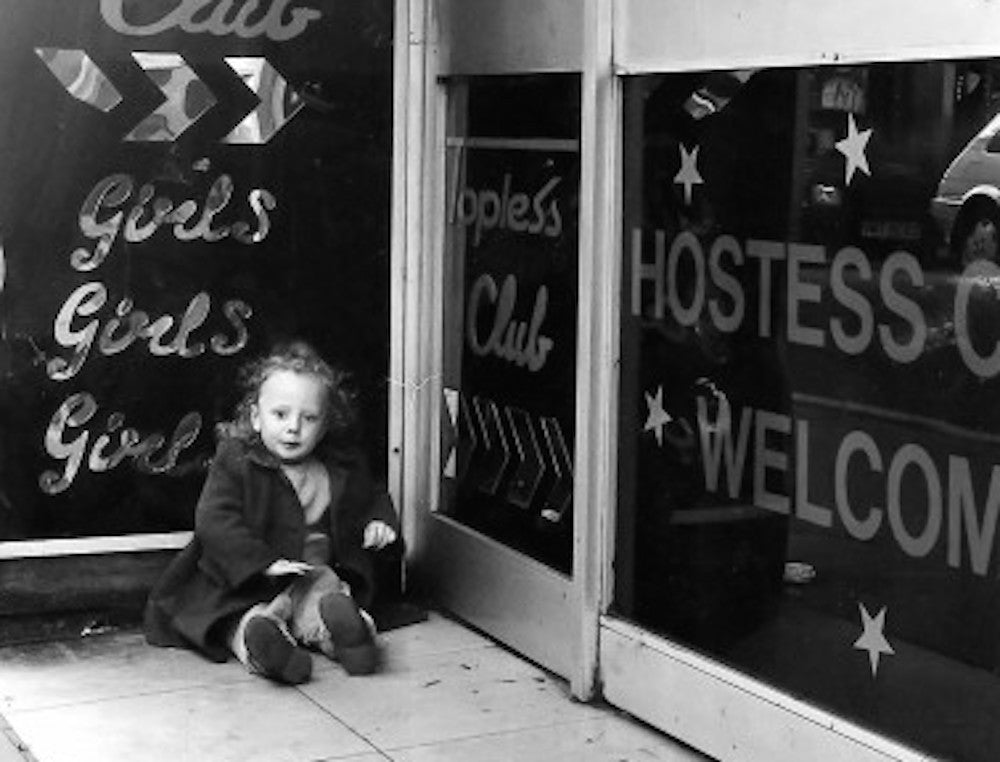
All photos are by Tish Murtha © Ella Murtha, All rights reserved.